Greece and Rome — birth and early life, the twelve labours, Olympia, and the Roman cult of Hercules
Greece
The birth and early life of Heracles
The birth of Heracles
Heracles was born in Thebes to Alcmene (a mortal woman, descendant of Perseus) and Zeus, who had disguised himself as her husband Amphitryon
this made Heracles a demi-god — half human, half divine
Zeus boasted that his son would rule the earth; Hera, enraged by Zeus's infidelity, intervened
Hera persuaded the goddess of childbirth Eileithyia to delay Alcmene's labour until the son of Sthenelus (a descendant of Perseus) was born first — that son was Eurystheus, who became king of Mycenae instead of Heracles
Hera then sent two snakes to kill the infant Heracles in his crib — Heracles strangled them both
frightened by Hera's continued wrath, Alcmene abandoned Heracles; he was found and raised with the help of Athena, who became his protector
The early life of Heracles
when Heracles came of age he married Megara, daughter of the king of Thebes
Hera sent the goddess Madness to infect Heracles — driven insane, he killed his wife and children
in his grief Heracles went to the oracle at Delphi to ask what he should do — unknown to him, Hera controlled the oracle
the oracle told him to serve King Eurystheus for ten years
Eurystheus set Heracles ten labours, believing them impossible; two were later disqualified, giving Heracles two more — making twelve in total
Hera's persecution of Heracles runs through his whole life — from his birth to his labours to his death. This matters for the exam because it shows the gods behaving in recognisably human ways: jealous, vindictive, willing to use their power to settle personal grievances. Heracles is not simply a strong man doing heroic things — he is a figure caught between the favour of his divine father and the hatred of his divine stepmother. That tension is what makes the myths dramatically interesting.
Exam focus
Why was Heracles a demi-god?
Why did Hera persecute Heracles from birth?
How did Heracles come to undertake the twelve labours?
What does the story of Heracles' birth tell us about the relationship between gods and humans?
Greece
The twelve labours
Overview
Eurystheus set the labours believing they were impossible — each one was designed to be beyond human capability
during two of the labours Heracles received help or payment; Eurystheus disqualified these and gave him two replacements, making twelve in total
the labours show Heracles using both strength and intelligence — not brute force alone
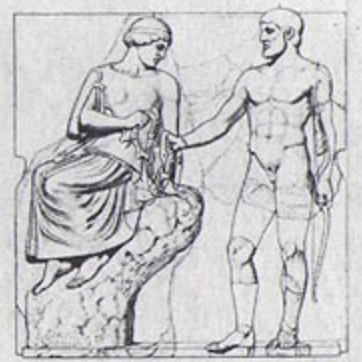
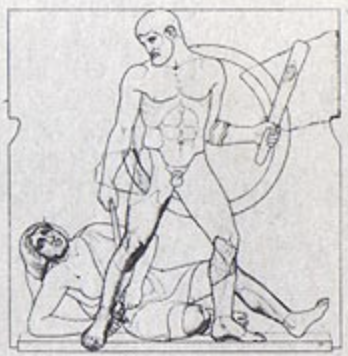
they are depicted on the twelve metopes of the Temple of Zeus at Olympia (prescribed visual source)
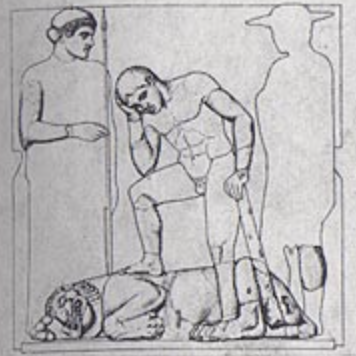
Labour 1The Nemean Lionview metope
Labour 1 — the Nemean Lion · metope, Temple of Zeus, Olympia
a lion terrorising the hills of Nemea, raised by Hera
Heracles discovered the lion's skin was impenetrable to weapons — he strangled it to death
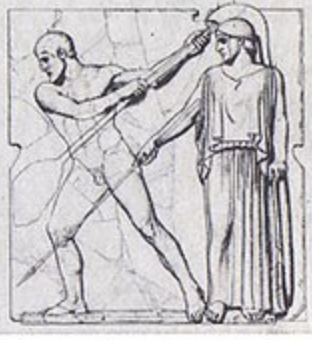
he could not skin it with his knife; Athena told him to use the lion's own claws
from this point Heracles wore the lion skin as a cloak with the lion's head as a helmet — his most distinctive attribute in art
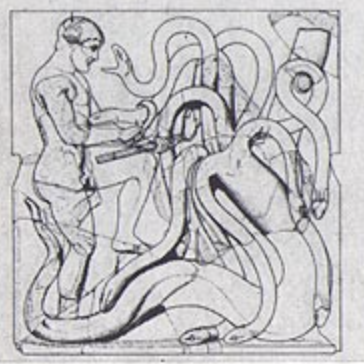
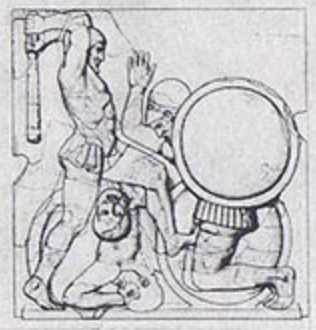
Labour 2The Lernaean Hydraview metope
Labour 2 — the Lernaean Hydra · metope, Temple of Zeus, Olympia
a many-headed water serpent with venom for blood; when one head was cut off, two more grew back
Heracles got help from his cousin Iolaus: after each head was removed, Iolaus sealed the neck with a flaming torch to stop regrowth
the immortal head was detached and buried under a pile of rocks
Eurystheus disqualified this labour because Heracles received help — one of the two replacements
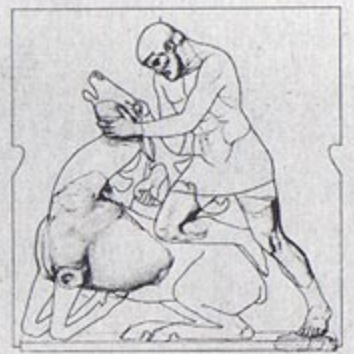
Labour 3The Golden Hindview metope
Labour 3 — the Golden Hind · metope, Temple of Zeus, Olympia
a deer sacred to Artemis, larger than a bull and golden from horns to hooves
Heracles tracked it for a whole year before catching it
Artemis was angry — Heracles explained he had been forced to catch it and only intended to borrow it; she let him continue
accounts differ on how he caught it: one says he snared it while sleeping, another says he shot it as it crossed a stream
what it tells us: heroism here is endurance and tact — a year of tracking, and a careful negotiation with an angry goddess, not a fight.
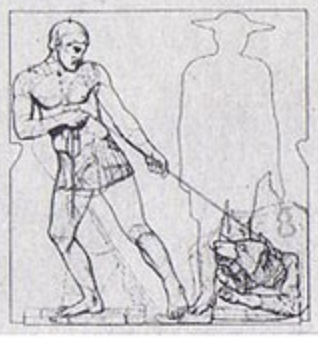
Labour 4The Erymanthian Boarview metope
Labour 4 — the Erymanthian Boar · metope, Temple of Zeus, Olympia
a huge boar terrorising the countryside of Arcadia
Heracles wore it down by chasing it through thick winter snow until it was exhausted, then bound its legs and carried it back
on seeing the boar, Eurystheus was so frightened he hid in a sunken pithos (large storage jar) — a recurring comic detail in the myths
what it tells us: the king who set the labours is a coward — the contrast makes the injustice of Heracles having to serve him sharper.
Labour 5The Augean Stablesview metope
Labour 5 — the Augean Stables · metope, Temple of Zeus, Olympia
Augeas, King of Elis, owned an enormous herd of cattle whose stables had never been cleaned
Heracles diverted the rivers Alpheius and Peneius through the stables, cleaning them instantly
Augeas had promised payment; when the task was done he refused to pay
Eurystheus disqualified this labour because Heracles had been offered money — giving him his second replacement
Heracles later returned with an army, defeated Augeas, and founded the Olympic Games in honour of Zeus to celebrate his victory (see Olympia panel)
Labour 6The Stymphalian Birdsview metope
Labour 6 — the Stymphalian Birds · metope, Temple of Zeus, Olympia
man-eating birds ravaging the farmland of Stymphalos in Arcadia
Heracles could not rouse them from the marsh; Athena gave him a bronze rattle made by Hephaistos
the noise frightened the birds into the sky; Heracles shot them down with his arrows
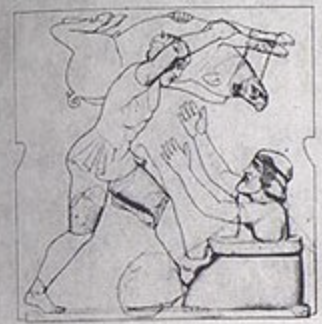
Labour 7The Cretan Bullview metope
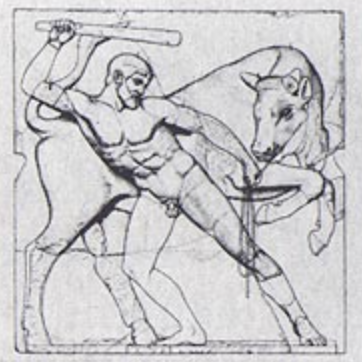
Labour 7 — the Cretan Bull · metope, Temple of Zeus, Olympia
a bull destroying homes and farmland on Crete; King Minos was happy for Heracles to remove it
Heracles crept up behind the bull, strangled it without letting it lose consciousness, and rode it across the sea back to Greece
Eurystheus was again terrified and hid; Heracles released the bull, which wandered to Marathon where it was later killed by Theseus
Labour 8The Mares of Diomedesview metope
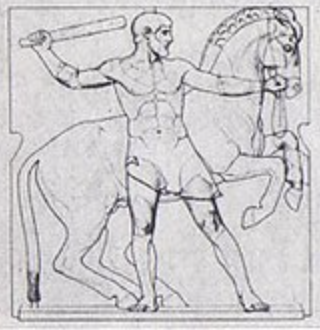
Labour 8 — the Mares of Diomedes · metope, Temple of Zeus, Olympia
Diomedes, King of the Bistones in Thrace, kept horses fed on the flesh of defeated enemies and strangers — they were crazed and dangerous
Heracles defeated Diomedes's men; while he was away fighting, the horses killed his companion Abderos
in retaliation Heracles fed Diomedes to his own horses; once fed, the horses were calm
accounts differ on what happened to the horses: one says they roamed the plains of Argos, another that they were killed by wild animals on Olympus
Labour 9The Belt of Hippolyteview metope
Labour 9 — the Belt of Hippolyte · metope, Temple of Zeus, Olympia
Hippolyte, queen of the Amazons, had a magical belt given to her by her father Ares; Eurystheus's daughter wanted it
Hippolyte admired Heracles and offered him the belt freely — but Hera disguised herself as an Amazon and spread rumours that Heracles planned to kidnap the queen
the Amazons attacked; Heracles, thinking Hippolyte had planned a trap all along, killed her and took the belt
what it tells us: Hera's interference turns what should have been a peaceful exchange into a tragedy — Heracles completes the labour but at a moral cost.
Labour 10The Cattle of Geryonview metope
Labour 10 — the Cattle of Geryon · metope, Temple of Zeus, Olympia
Geryon was a monster with three heads and three sets of arms and legs, living at the edge of the known world
Heracles had to travel beyond the Greek world — through southern Spain and southern France, then down through Italy
it was on this return journey through Italy that the Romans placed the story of Hercules and Cacus (see Rome panel)
Geryon was defeated with Heracles's club and bow; on return, Eurystheus sacrificed the bulls to Hera
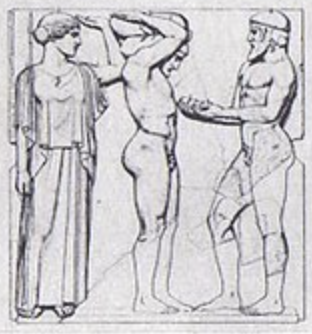
Labour 11The Apples of the Hesperidesview metope
Labour 11 — the Apples of the Hesperides · metope, Temple of Zeus, Olympia
golden apples belonging to Zeus and Hera, guarded by the Hesperides (daughters of Atlas) and a serpent, in a garden at the edge of the world
Heracles freed the Titan Prometheus from his eagle on Mount Caucasus; in gratitude, Prometheus told him how to get the apples
Heracles offered to hold up the sky while Atlas fetched the apples; when Atlas returned he offered to deliver the apples himself rather than take back the sky
Heracles tricked him — asking Atlas to hold the sky for a moment while he adjusted a cushion for his shoulders, then picked up the apples and ran
the apples could not stay with Eurystheus — being the property of Zeus, Athena returned them to the garden
what it tells us: Heracles wins through cunning, not strength — this is the labour examiners use when challenging the idea that he relied on brute force.
Labour 12Cerberusview metope
Labour 12 — Cerberus · metope, Temple of Zeus, Olympia
Eurystheus sent Heracles to the Underworld to capture Cerberus, the three-headed hound of Hades, without using weapons
Heracles was initiated into the Eleusinian Mysteries to gain Persephone's favour before entering
Hades agreed: if Heracles could capture Cerberus without weapons, he could take him
Heracles used the stranglehold that had worked on the Nemean Lion; after presenting Cerberus to Eurystheus, he was returned to Hades to guard the entrance again
in Homer's Odyssey, Odysseus meets the ghost of Heracles in the Underworld, who describes this labour
The labours are not just a list of monsters. Taken together they build a portrait of what heroism meant to the Greeks: physical strength, yes, but also intelligence (tricking Atlas, diverting the rivers), endurance (tracking the hind for a year), and the ability to improvise when things go wrong (Iolaus with the torch, using the lion's own claws). The fact that Hera engineered the labours in the first place — and that Eurystheus keeps trying to disqualify them — gives the whole sequence an edge of injustice that makes Heracles's eventual success feel earned.
Exam focus
Describe what happened in any two of Heracles's labours.
What heroic qualities did Heracles display during the labours? Give specific examples.
Why did Eurystheus give Heracles two extra labours?
'Heracles always used brute force over intelligence.' How far do you agree?
Greece
Heracles and Olympia
The founding of the Olympic Games — two versions
the traditional date for the founding of the Olympic Games is 776 BC; the site was at Olympia in Elis, in the western Peloponnese
the Greeks told two competing stories about the games' origins — both were represented in the architecture of the Temple of Zeus at Olympia
Version 1Pelops and Hippodamia
Oinomaos, king of Pisa (a town near Olympia), had been told by an oracle he would die when his daughter married
he challenged all suitors of his daughter Hippodamia to a chariot race — winners married her, losers were killed; many had died before Pelops arrived
Pelops bribed Oinomaos's charioteer to replace the bronze linchpins of his chariot with wax ones
during the race the wax melted; Oinomaos was thrown from the chariot and killed
Pelops married Hippodamia and founded the Olympic Games as funerary games in honour of Oinomaos
this story was depicted on the eastern pediment of the Temple of Zeus at Olympia
Version 2Heracles and the Augean Stables
after completing his fifth labour (cleaning the Augean Stables), Augeas refused to pay Heracles as promised
Heracles returned with an army, defeated Augeas, and marched on Elis
he founded the Olympic Games in honour of Zeus and built six altars to the twelve gods
this story was depicted on the twelve metopes of the Temple of Zeus
The Temple of Zeus at Olympiaprescribed visual sourceview metope
Heracles & the Cretan Bull · metope, Temple of Zeus, Olympia
Date: building began 472 BC
Material: local marble
Location: Olympia; metopes now in the Olympia Museum
Significance: the labours of Heracles are shown on twelve metopes — six above the front entrance, six above the back; their presence on a temple dedicated to Zeus emphasises Heracles's importance to the site and to the games
the sculptor had three objectives when designing the metopes: create a scene that could be easily recognisable; create realism; fill the space without large blank areas
key metope: Heracles wrestling the Cretan Bull — Heracles holds his club even though the myth says he strangled it (to help identification); his abdominals twist realistically with the effort; the bull rears away; the two figures form a cross shape to fill the square space
The two founding stories of the Olympics were not seen as contradictory — both were displayed on the same temple. The Pelops story placed the games in a tradition of Greek heroic myth; the Heracles story connected them directly to the twelve labours and to the worship of Zeus. Together they gave Olympia a layered religious and mythological significance that made the site more than just a sports venue. The metopes make Heracles permanently visible on Zeus's own temple — a statement about the relationship between the hero and the god he served.
Exam focus
Describe the two stories about the founding of the Olympic Games.
Where are the labours of Heracles depicted on the Temple of Zeus, and why is this significant?
Study the metope of Heracles and the Cretan Bull. How has the sculptor created a recognisable and realistic scene?
Why might the architect have chosen to display the labours of Heracles on a temple dedicated to Zeus?
Rome
Hercules and Cacus — Virgil, Aeneid 8.154–279
Prescribed source facts
Author: Virgil (Publius Vergilius Maro)
Date: 19 BC
Genre: epic poetry
Protagonist: Hercules
Significance: explains why the Romans worshipped Hercules; establishes his cult in Rome; connects his story to the site of Rome itself before the city was founded
read it in: OCR sources booklet
Context
the story takes place during Hercules's tenth labour — returning the Cattle of Geryon to Eurystheus
the area around the Tiber was not yet Rome — it was inhabited by Arcadian settlers led by Evander; the story is set around 500 years before Romulus founded Rome
when the hero Aeneas arrives at Evander's city (Pallantium), Evander is already holding an annual sacrifice to Hercules — and tells Aeneas the story of why
Cacus's lairlines 190–199
Cacus was a half-human monster, son of Vulcan, who lived in a cave on the Aventine Hill
his lair was described by Evander: a rocky, overhanging cliff; crags pulled down in ruin; a cave receding to vast depths; the ground always warm with fresh blood; the heads of men nailed to the doors
Cacus breathed fire and terrorised the people of Pallantium
what it tells us: Virgil builds up the horror of the monster so that Hercules's eventual victory feels like a service to the future site of Rome.
Cacus steals the cattlelines 200–212
while Hercules slept, Cacus stole eight of his cattle and dragged them into his cave backwards — so the hoof prints led away from the cave, not towards it
Hercules was fooled until a single trapped cow mooed as he was preparing to leave — revealing the cattle's location
The chase and the killlines 213–268
Hercules was seized with rage — he grabbed his weapons and club and charged up the mountain
Cacus fled to his cave and blocked the entrance with a huge boulder; Hercules could not move it
Hercules circled the Aventine Hill three times in frustration; three times he tried the doorway; three times he sank back exhausted
finally he spotted a flint peak on top of the mountain, used his body weight to lift the top of the mountain clean off, and exposed Cacus in his lair
Cacus breathed black smoke to conceal himself; Hercules leapt through the flames, seized Cacus in a knot-like stranglehold (the same grip used on the Nemean Lion), and choked him to death
he brought the body out to show Evander and his people
what it tells us: the threefold attempts and the stranglehold callback to the Nemean Lion deliberately echo Greek heroic patterns — Virgil is fitting Hercules into the epic tradition.
The cult of Hercules in Romelines 268–279
Evander established an annual sacrifice at the Great Altar of Hercules in the Forum Boarium (cattle market), between the Tiber and the Palatine Hill
only men were allowed to take part — the ritual involved sacrificing an animal and burning incense
Evander named the altar "the Mightiest" and declared it would be honoured for ever
in the second century BC the Temple of Hercules the Victor was built in the same area — it still stands today
the cult was initially run by two Roman families (the Potitii and Pinarii); in 312 BC responsibility passed to a selected group of slaves — making Hercules particularly popular with the Roman lower classes and gladiators
Virgil's account does two things at once. It tells a gripping story — Cacus is one of the most vividly described monsters in the whole tradition, his lair full of blood and severed heads — and it provides a foundation myth for Roman religious practice. The annual sacrifice Evander establishes is still being performed when Aeneas arrives, centuries later. That continuity matters to Romans: it says the worship of Hercules is ancient, legitimate, and woven into the very landscape of Rome before Rome even existed.
Exam focus
How does Virgil create a vivid picture of Cacus and his lair?
Did Hercules use brains or brawn in his fight with Cacus? Use the text in your answer.
What did Evander do to thank Hercules, and why was this significant to the Romans?
Why do you think Hercules deserved to become a god? Use the source and your own knowledge.
Rome
Hercules and Achelous; the death of Hercules — Ovid, Metamorphoses 9.1–272
Prescribed source facts
Author: Ovid (Publius Ovidius Naso)
Date: AD 8
Genre: poetry
Protagonist: Hercules
Prescribed lines: 9.1–272
Significance: shows Hercules as both hero and flawed human; his death and transformation into a god; explores the relationship between gods, heroes, and mortals
read it in: OCR sources booklet
Context — how the story is told
the story is told to the hero Theseus by the river god Achelous himself, while they wait for floodwaters to recede
Achelous tells it as the story of how he lost his horn — a tale of personal defeat at Hercules's hands
Hercules and Achelous — the argumentlines 11–26
both Hercules and Achelous wanted to marry Deianira, princess of Aitolia
Achelous argued that his status as a god was superior to Hercules's status as a mortal man; he also attacked Hercules's birth, calling it either a lie or a scandal
Hercules countered by claiming his divine parentage (Zeus) and his labours as proof of his worth
Achelous admits in telling the story: the shame of being beaten is no less than the honour of having fought — it is a consolation that the victor was so famous
Hercules and Achelous — the fightlines 27–86
Hercules won the first bout through strength
Achelous used his divine power to transform into a serpent — Hercules mocked him, saying he had already defeated the Lernaean Hydra, a far greater threat
Achelous then transformed into a single-horned bull; the audience would have recalled the Cretan Bull from the labours
Hercules won this final bout, breaking off Achelous's single horn — which was then filled with fruit and became the cornucopia (horn of plenty)
Hercules and Nessuslines 97–133
having won Deianira, Hercules set off home to Tiryns
at the river Evenus, the centaur Nessus offered to carry Deianira across while Hercules swam
Nessus tried to run off with Deianira; Hercules shot him with an arrow tipped with the venom of the Lernaean Hydra
dying, Nessus murmured to Deianira that his blood-soaked tunic would act as a love charm — if Hercules ever loved another woman, giving him the tunic would win him back
this was a trap — the venom in Nessus's blood would destroy Hercules
The death of Herculeslines 133–272
years later, Juno (Hera) used the goddess Rumour to spread lies that Hercules was in love with Iole, a princess from Oechalia
Deianira, believing this, gave Hercules the tunic of Nessus hoping to rekindle his love — not knowing what it would do
while sacrificing at an altar, the heat caused the tunic to catch light and stick to his skin; the venom began destroying him
in agony, Hercules built his own funeral pyre on Mount Oeta, lay on it, and died
Jupiter (Zeus) gave a speech to the assembled gods: Hercules's mortal part would burn away; his divine part would live on
the gods agreed — even Juno — and Hercules shed his human form and ascended to Olympus, becoming a god
Ovid's Hercules is more complicated than the straightforward hero of the labours. The fight with Achelous shows him at his most impressive — outwitting a shape-shifting river god using the experience of previous labours. But the death sequence strips all that away. Hercules, who strangled the Nemean Lion and defeated Cacus, is destroyed not by a monster but by a piece of clothing — and by a chain of misunderstanding involving his wife, a dying centaur, and a jealous goddess. Ovid seems to suggest that the divine world is chaotic enough that even the greatest hero cannot escape it. His death earns him godhood, but it is an ugly, painful way to get there.
Exam focus
How does Achelous characterise Hercules in his account of their fight?
What does the fight with Achelous tell us about Hercules's heroic qualities?
How does Nessus bring about the death of Hercules?
How does Ovid create a vivid and dramatic account of Hercules's death?
Why do you think Jupiter argued that Hercules deserved to become a god?
Greece & Rome
Heracles/Hercules compared
Similarities
Both cultures recognised Heracles/Hercules as the supreme hero — stronger, more enduring, and more widely tested than any other
Both told the same core myths: the labours, the fight with the Hydra, the capture of Cerberus
Both connected him to the Underworld — he entered it alive during his twelfth labour; Odysseus meets his ghost there in Homer
Both celebrated him through visual art — the metopes at Olympia (Greece), sarcophagi decorated with his labours (Rome)
Both associated him with divine parentage and ultimate deification — he ends his story as a god in both traditions
Key differences
Greece honoured Heracles primarily through the Olympic Games and the metopes of the Temple of Zeus — connecting him to Zeus, to athletic competition, and to the idea of heroic endeavour rewarded
Rome honoured Hercules through a specific foundation story (Cacus) tied to the landscape of Rome itself — the Forum Boarium, the Aventine Hill, the Great Altar — giving him a physical presence in the city
in Rome, Hercules was worshipped by slaves, freedmen, and gladiators in particular — because the cult was run by slaves from 312 BC; this gave him a popular following with no direct Greek equivalent
the Cacus story is distinctly Roman — it does not appear in Greek sources; it was invented to explain why Rome worshipped Hercules and to root the myth in Italian geography
Ovid's Hercules in the Metamorphoses is more psychologically complex than the straightforward hero of the Greek labours — his death is chaotic, painful, and caused by human misunderstanding as much as divine hostility
Both cultures used Heracles/Hercules to explore the same question: what does it take for a mortal to become divine? The Greek answer, shown through the labours and Olympia, is endurance and service — complete enough impossible tasks and you earn your place among the gods. The Roman answer, shown through Virgil and Ovid, adds a civic dimension: Hercules matters to Rome because he protected its people before Rome even existed, and because his worship is embedded in the very ground of the city. Greece honoured a universal hero; Rome claimed him as specifically their own.
Exam focus
Give one similarity and one difference between how Greece and Rome honoured Heracles/Hercules.
Who honoured Hercules more — the people of Olympia or the Romans? Use specific evidence in your answer.
How does the story of Hercules and Cacus explain why the Romans worshipped Hercules?
What does Ovid's account of Hercules's death add to our understanding of the hero that the labours alone do not?
Greece & Rome
Heracles as a hero
What makes Heracles heroic
Strength: he kills monsters that no ordinary human could face — the Nemean Lion, the Hydra, Cacus, Geryon
Endurance: the labours span years; he tracks the Golden Hind for a whole year; he travels to the edge of the known world and beyond
Intelligence: he is not purely a figure of brute force — he diverts rivers to clean the stables, tricks Atlas, uses Iolaus with the torch against the Hydra, uses a rattle against the Stymphalian Birds
Courage: he enters the Underworld alive; he leaps through Cacus's smoke and fire; he takes on a shape-shifting river god without hesitation
Divine favour: Athena protects and guides him throughout — she tells him how to skin the Nemean Lion, gives him the rattle for the Stymphalian Birds, receives the apples of the Hesperides from him at the end
Perseverance under injustice: the labours were imposed on him unfairly — Hera engineered his madness, Eurystheus keeps trying to disqualify his successes; he completes them anyway
What makes Heracles complicated
he killed his own wife and children while driven mad by Hera — the labours are effectively his punishment for this, even though the madness was not his fault
he receives help during the labours — Iolaus, Athena, Prometheus — which Eurystheus uses to disqualify two of them; the line between heroic and assisted is blurred
in Ovid's account he is destroyed not by a monster but by a piece of clothing — the greatest hero of the ancient world is undone by a misunderstanding between his wife and a dying centaur
his rage is dangerous as well as heroic — in the Aeneid Virgil shows him seized with venomous dark rage against Cacus; in the Hippolyte labour his temper leads him to kill the queen who was going to give him the belt freely
he is caught between two divine parents — Zeus's favour and Hera's hatred define his entire life; he has little control over his own fate
The tension between human and divine
Heracles is neither fully human nor fully god — he is the most powerful mortal alive, but still mortal; he can be wounded, exhausted, driven mad
his death in Ovid shows this tension at its sharpest: his human body is destroyed by the venom while his divine nature survives to ascend to Olympus
Jupiter's speech at the end of the Metamorphoses makes the argument explicit: the fire of the pyre will burn away everything mortal, leaving only what he inherited from Zeus
the Greeks called figures like Heracles demi-gods — half human, half divine — but his story is really about what it costs to earn full divinity; the answer is everything
Heracles is the most important hero in the ancient world precisely because he contains contradictions. He is the strongest man alive and also the man who killed his own children. He completes twelve impossible labours and is then destroyed by a garment. He is favoured by Zeus and persecuted by Hera. These contradictions are not flaws in the myth — they are the point. The Greeks and Romans used Heracles to ask a question that mattered to them: what does it take for a human being to become something more than human? The answer the myths give is that it takes not just strength but suffering, not just heroism but endurance of injustice, and ultimately the willingness to burn away everything mortal.
Exam focus
What heroic qualities does Heracles display across the sources? Give specific examples.
In what ways is Heracles a complicated or flawed hero?
What does the story of Heracles's death tell us about the relationship between his human and divine natures?
'Heracles is a hero because of his strength alone.' How far do you agree?
Greece & Rome
Who honoured Heracles more — Greece or Rome?
The case for Greece
the Greeks gave Heracles the Olympic Games — the most important sporting and religious event in the ancient world, held every four years at Olympia in honour of Zeus; one founding tradition places Heracles at the origin of the games itself
his labours are depicted on the twelve metopes of the Temple of Zeus at Olympia — carved in stone on the most important temple at one of Greece's most sacred sites; this is a permanent, monumental statement of his importance
the Homeric tradition places him throughout Greek myth — Odysseus meets his ghost in the Underworld; he is the model against which all other heroes are measured
he was worshipped across the entire Greek world, not just in one city or region — his myths were pan-Hellenic, belonging to all Greeks
the Eleusinian Mysteries are connected to his story — he was initiated into them before his twelfth labour, linking him to the most important mystery cult in Greece
The case for Rome
Rome gave Hercules a specific foundation story tied to the physical landscape of the city — the Forum Boarium, the Aventine Hill, the Tiber; his cult was embedded in Rome before Rome even existed, according to Virgil
Evander established an annual sacrifice at the Great Altar of Hercules in the Forum Boarium — a continuous act of worship maintained for centuries
the Temple of Hercules the Victor was built in the Forum Boarium in the second century BC and still stands — a lasting physical monument in the heart of Rome
from 312 BC the cult was run by slaves, making Hercules popular with slaves, freedmen, and gladiators — a broad popular following that gave him a reach across Roman society that no Greek cult quite matched
Roman sarcophagi were frequently decorated with his labours — wealthy Romans used his image to dignify death and suggest heroic virtue; this is a direct, personal use of the myth with no equivalent scale in Greece
Virgil's Aeneid places him alongside Aeneas in the founding tradition of Rome — connecting Hercules to the deepest roots of Roman identity
Reaching a judgement
For Greece: the Olympic Games and the Temple of Zeus metopes represent a scale of civic and religious honour that is hard to match — the games were pan-Hellenic, attended by Greeks from across the world, and Heracles was at their origin
For Rome: the cult of Hercules was more personally embedded in Roman life — in the landscape of the city, in the worship of ordinary people and slaves, in the decoration of coffins; the Greek honour was grander but the Roman honour was deeper and more daily
A balanced conclusion: Greece honoured Heracles on a larger and more monumental scale; Rome made him more personally present in the lives of its people — the answer depends on whether you measure honour by grandeur or by intimacy
This question does not have a single right answer — and that is the point. The examiner wants to see you building an argument with evidence on both sides before reaching a supported conclusion. The strongest answers will make a clear judgement and stick to it, using specific details from both traditions. Avoid simply listing facts for each side — ask yourself: what kind of honour matters more? A hero carved in stone on a sacred temple, or a hero worshipped daily by the people who built the city?
Exam focus
Who honoured Hercules more, the people of Olympia or the Romans? Use specific evidence in your answer. [15]
Give one way Greece honoured Heracles and one way Rome honoured Hercules.
How does Virgil's account of Hercules and Cacus help explain why Rome worshipped Hercules?
What does the popularity of Hercules among Roman slaves and gladiators tell us about how Rome used the myth?
Flashcards
30 cards — click to flip, use arrows to move through