8-Mark Question: Heracles

📚 GCSE Classical Civilisation ⏱️ 50 min lesson 📊 Topic 2: Heracles

Learning Intention

Understand how to construct a well-argued 8-mark response that groups evidence thematically and balances AO1 knowledge with AO2 analysis.

Success Competencies:

  • 1. I can group multiple labours into thematic arguments (e.g. "several labours show intelligence") rather than listing them one by one
  • 2. I can balance AO1 knowledge (specific details, Greek names, what happened) with AO2 analysis (explaining WHY evidence matters, evaluating different viewpoints)
  • 3. I can structure a balanced argument that considers both sides of the question (AGREE → DISAGREE → OVERALL JUDGEMENT) and uses Source A effectively throughout

Today's Objective

You will plan and structure an 8-mark response about Heracles' labours, evaluating whether he was more of a brute or a true hero. This lesson prepares you to write your full answer for homework.

Source A
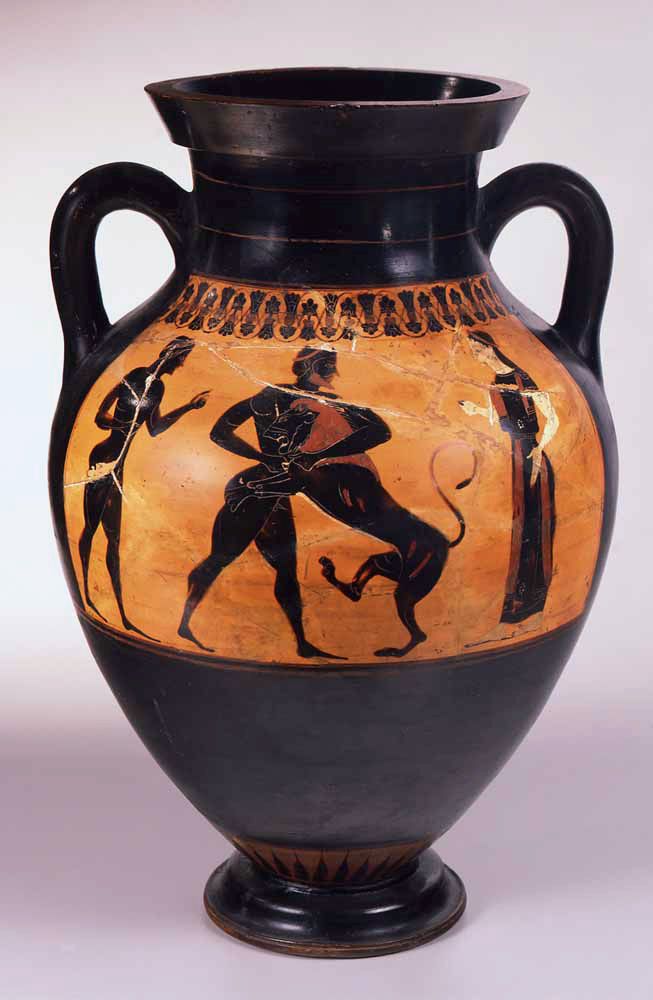
Heracles wrestling the Nemean Lion
Ancient Greek vase showing Heracles using brute strength against the Nemean Lion
'Heracles' labours show he was more of a brute than a true hero.' How far do you agree with this assessment? Use Source A as a starting point and your own knowledge in your answer.
[8]

Understanding the Question

This question asks you to evaluate - that means weighing up both sides of the argument. You need to:

  • Consider evidence that Heracles was just a brute (used only physical strength, violence)
  • Consider evidence that he was a true hero (cleverness, courage, serving Greece)
  • Use Source A AND your knowledge of other labours
  • Reach a balanced judgement
Key Terms
Brute: Someone who relies only on physical force and violence, without thinking or moral purpose
True Hero: Someone who shows courage, intelligence, serves others, completes difficult tasks for noble purposes

How to Structure an 8-Mark Answer

1
Address Question
State your overall judgement clearly
2
Use the Source
Analyse what Source A shows about the question
3
Add Evidence
Use other labours to support your argument
4
Other Side
Consider the alternative viewpoint
5
Conclude
Reach a balanced final judgement

Assessment Objectives Reminder

AO1: Knowledge (4 marks)
  • Specific details from Source A
  • Names of labours (Greek names)
  • What happened in each labour
  • Details about monsters/tasks
  • Context (why labours, Eurystheus)
AO2: Analysis (4 marks)
  • Argue for/against the statement
  • Explain WHY evidence matters
  • Evaluate different viewpoints
  • Make connections between labours
  • Reach a reasoned judgement

Evidence Bank: The Labours

Click on each labour below to reveal the key details. Then discuss as a class: could this labour be used to argue he was a brute, a hero, or both? What specific details support each interpretation?

🦁
Nemean Lion
(Source A)
🐍
Lernaean Hydra
Multi-headed serpent
🐗
Erymanthian Boar
Capture alive
🦌
Ceryneian Hind
Sacred deer
🏛️
Augean Stables
30 years of filth
🦅
Stymphalian Birds
Man-eating flock
🐂
Cretan Bull
Fire-breathing
🐴
Mares of Diomedes
Man-eating horses
⚔️
Hippolyta's Belt
Amazon queen
🐄
Cattle of Geryon
Three-bodied giant
🍎
Golden Apples
Garden of Hesperides
🐕
Cerberus
Guardian of Underworld

Building Your Argument: Thematic Points

Don't just list labours one by one! Group your evidence into thematic arguments that use multiple labours as examples. Click each point below to see how to develop it.

AGREE Side: Arguments for "More of a Brute"
💪 Many labours relied purely on physical strength
⚔️ His solutions involved violence and killing
🎨 His symbols represent primitive savagery
DISAGREE Side: Arguments for "True Hero"
🧠 Many labours required intelligence and problem-solving
🛡️ He received divine favour and assistance
🎯 He showed skill, control, and restraint
🌍 He served Greece by removing monsters (civilisation vs chaos)

Sentence Starters & Connectives

Making Your Points

  • • In multiple labours...
  • • Several examples demonstrate...
  • • Throughout the labours, Heracles...
  • • Evidence for this can be seen in...

Using Source A

  • • Source A depicts Heracles...
  • • As shown in Source A...
  • • The source illustrates...
  • • We can see from Source A that...

Adding More Evidence

  • • Furthermore,...
  • • Similarly,...
  • • In addition to this,...
  • • Another example is...

Counter-Arguments

  • • However,...
  • • On the other hand,...
  • • Despite this,...
  • • It could be argued that...

Explaining Why

  • • This demonstrates that...
  • • This suggests...
  • • This shows that Heracles...
  • • This is significant because...

Conclusions

  • • Overall,...
  • • In conclusion,...
  • • On balance,...
  • • Ultimately, Heracles was...

Suggested Answer Structure

Paragraph 1: AGREE (100 words)
• Pick 2-3 thematic points from AGREE side
• Start with Source A, then add other labours
• Explain WHY this shows he's a brute
Example: Physical strength point + violence point
Paragraph 2: DISAGREE (100 words)
• Use "However..." to transition
• Pick 2-3 thematic points from DISAGREE side
• Group multiple labours as evidence
Example: Intelligence point + divine favour point
Paragraph 3: OVERALL JUDGEMENT (50-80 words)
• "Overall..." or "In conclusion..."
• Make your final decision
• Show you've weighed both sides

Example 8-Mark Answer

Here's a Level 4 example answer to a different question so you can see the structure and technique. Notice how AO1 (knowledge) and AO2 (analysis) work together, and how the source is used.

Source B
"Heracles went to Delphi and asked the priestess what he should do. The Oracle told him to go to Tiryns and serve King Eurystheus for twelve years. If he completed the ten labours Eurystheus set for him, he would become immortal."
— Apollodorus, Library
'The twelve labours demonstrate that Heracles was a victim of the gods rather than a willing hero.' How far do you agree with this assessment? Use Source B as a starting point and your own knowledge in your answer.
[8]
Key for highlighting:
AO1 Knowledge
AO2 Analysis
Source Reference
AGREE Paragraph:

I partially agree with this assessment because Heracles was forced into the labours by circumstances beyond his control. He completed the twelve labours as punishment for killing his wife and children whilst under a curse of madness sent by Hera, Zeus's jealous wife. This was not his fault - he was a victim of divine manipulation. Source B shows that the Oracle at Delphi commanded him to "serve King Eurystheus for twelve years", demonstrating he had no choice in the matter. Furthermore, King Eurystheus designed the labours specifically to be impossible and to kill Heracles, such as sending him to the Underworld to capture Cerberus, the three-headed guard dog. No mortal should survive such a task, showing that Heracles was being victimised by both Hera and Eurystheus.

DISAGREE Paragraph:

However, there is strong evidence that Heracles was a willing hero who chose to complete the labours honourably. Source B reveals that Heracles "went to Delphi" himself - he voluntarily sought purification and accepted the labours as atonement, showing moral responsibility rather than victimhood. During the labours themselves, he showed heroic qualities that went beyond mere survival - for example, he diverted the rivers Alpheus and Peneus to clean the Augean Stables, demonstrating intelligence and problem-solving rather than just following orders. He also received help from the gods, particularly Athena, who gave him the bronze castanets to scare the Stymphalian Birds. This divine support suggests the gods recognised his heroism and wanted him to succeed, not simply to torture him. Furthermore, Source B states that if he completed the labours "he would become immortal", showing these were a path to ultimate heroic glory rather than pure victimisation.

OVERALL JUDGEMENT:

Overall, whilst Heracles was initially a victim of Hera's jealousy and divine manipulation, the way he completed the labours with courage, intelligence, and moral purpose transformed him into a true hero. The labours may have been imposed upon him, but his response to them demonstrated genuine heroism rather than passive victimhood.

What Makes This a Level 4 Answer?
AO1 Knowledge (4/4): Specific details throughout - Hera's curse, killing wife and children, Cerberus as three-headed guard dog, rivers Alpheus and Peneus, Stymphalian Birds with bronze castanets from Athena, Oracle at Delphi. All accurate with context.

AO2 Analysis (4/4): Clear argument structure with judgement, explains WHY evidence matters ("This demonstrates...", "This suggests...", "This was not his fault..."), considers both sides thoroughly, reaches balanced conclusion based on evidence. Every piece of knowledge is interpreted and evaluated.

Source Usage: Source B referenced THREE times - opening command to serve, voluntary seeking of Oracle, promise of immortality. Each time, the source detail is analysed to support the argument, not just described.

Structure: AGREE paragraph (victim side) → DISAGREE paragraph (willing hero) → OVERALL judgement. Each paragraph clearly signposted with connectives.

Writing Your Answer: Top Tips

1. Group Evidence Thematically
Don't write "In the Nemean Lion labour... In the Hydra labour..." Instead write "In multiple labours, Heracles used only brute strength - for example, Source A shows him strangling the Nemean Lion, and he similarly..."
2. Always Explain WHY
After giving evidence, always explain what it proves about the question. Don't just describe what happened - analyse what it MEANS. Use phrases like "This demonstrates...", "This suggests...", "This shows that..."
3. Use Source A Multiple Times
Start your AGREE or DISAGREE paragraph with Source A, but you can also reference it again later. Don't just mention it once at the start and forget about it.
4. Use Greek Names
Always use Greek names for the labours: Nemean Lion, Lernaean Hydra, Erymanthian Boar, Augean Stables, Stymphalian Birds, Cretan Bull, etc. This shows accurate knowledge and will help your AO1 marks.
5. Be Specific
Don't just say "He killed monsters." Say "He strangled the invincible Nemean Lion with his bare hands" or "He diverted the rivers Alpheus and Peneus to clean the Augean Stables." Specific details = higher AO1 marks.
6. Write in Paragraphs
Structure: AGREE paragraph → DISAGREE paragraph → OVERALL JUDGEMENT. Each paragraph should be substantial (80-100 words) and make clear points.
Success Criteria: Can You Tick All These?
  • I have used Source A and explained what it shows
  • I have grouped multiple labours into thematic arguments (not just listed them one by one)
  • I have used specific details with correct Greek names
  • I have explained WHY my evidence matters (not just described what happened)
  • I have written an AGREE paragraph with 2-3 arguments
  • I have written a DISAGREE paragraph with 2-3 arguments
  • I have written an OVERALL JUDGEMENT paragraph
  • I have used connectives to link my ideas smoothly
  • My answer is about 250-300 words (1-1.5 sides)

Homework Task

Using the evidence bank and thematic arguments from today's lesson, write your full answer to the 8-mark question:

'Heracles' labours show he was more of a brute than a true hero.' How far do you agree with this assessment?
  • Write 250-300 words (about 1-1.5 sides)
  • Use the thematic argument approach (group multiple labours together)
  • Remember to use Source A and your own knowledge
  • Check against the Success Criteria before submitting
  • Aim for Level 3-4 (5-8 marks) by including both AO1 knowledge and AO2 analysis