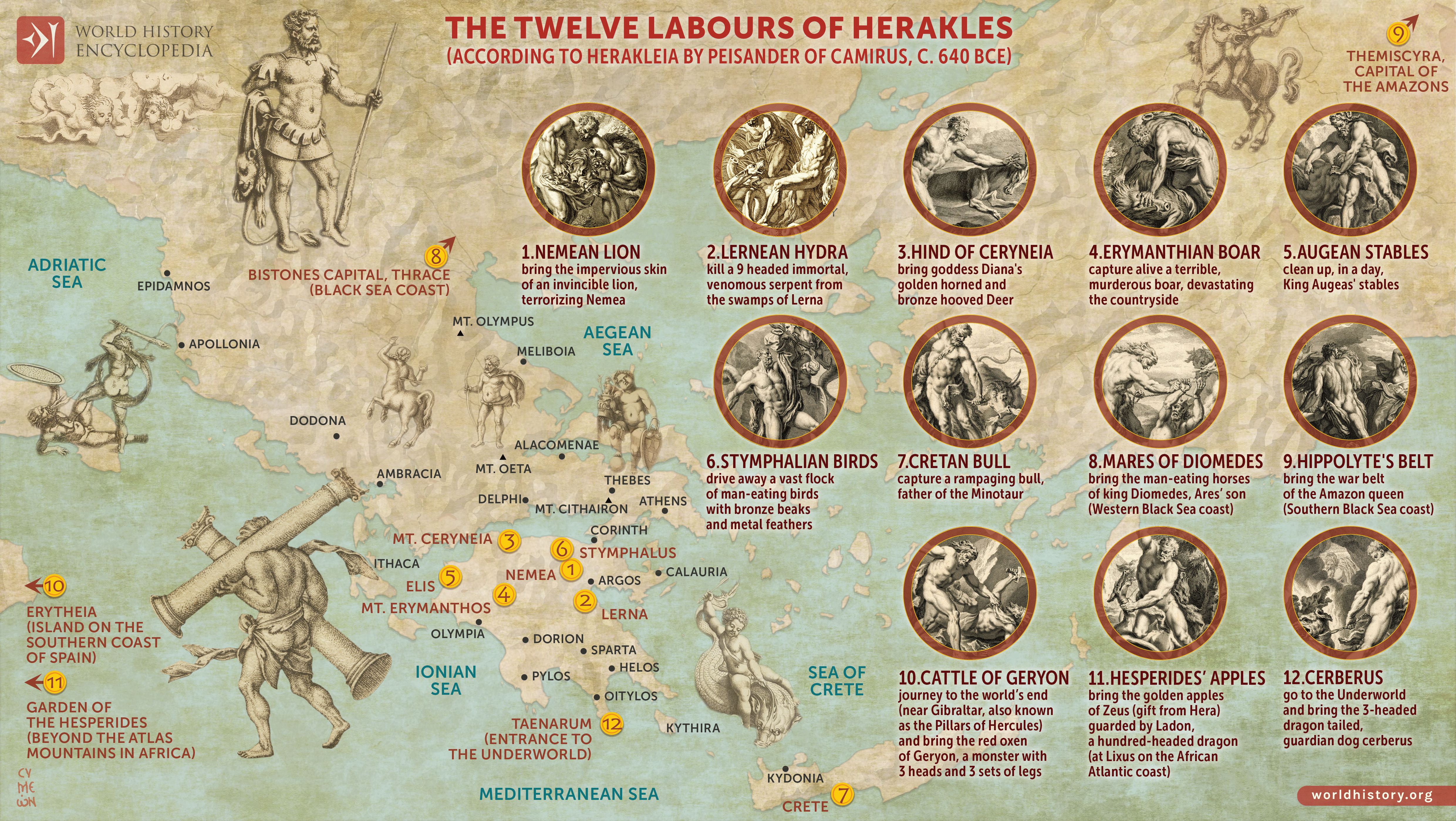
By the end of this section, you will understand how the final six labours expanded beyond the Peloponnese to the edges of the known world, analyse how Heracles overcame increasingly impossible challenges, and evaluate why the final labour (Cerberus) represented the ultimate heroic achievement.
Beyond the Known World
Having completed six labours in the Peloponnese, Heracles' tasks now took him far beyond familiar territory. These final six labours would send him to distant islands, the edge of the world, and finally to the Underworld itself - places where no mortal had gone and returned.
He crossed the inhabited world and the uninhabited, through sea and land, until he came to the limits of the earth and descended even to those below.
— Euripides, Heracles 1193-1197
These labours tested more than strength. They required divine aid, clever tricks, and the courage to face cosmic forces. Through them, Heracles proved he was worthy not just of fame, but of immortality itself.
The first six labours took place in the Peloponnese. The final six expanded to distant lands, the edge of the world, and even the realm of the dead. This progression showed Heracles becoming a universal hero, not just a local champion.
Labours 7-9: These took Heracles overseas - to Crete, Thrace, and the land of the Amazons. He left Greece proper and ventured into foreign territories, bringing civilisation to barbarous lands.
Labours 10-11: These pushed him to the very edge of the world - to Erytheia in the far west and the Garden of the Hesperides. Heracles literally expanded the boundaries of the known world, setting up the Pillars of Heracles at Gibraltar.
Labour 12: The final task transcended geography entirely. By descending to the Underworld and returning alive, Heracles conquered death itself - the ultimate barrier that separates mortals from gods.
Map of All Twelve Labours
This map shows the geographic progression of Heracles' labours. The first six (in green) remained within the Peloponnese, whilst the final six (in red) took him across the Mediterranean and beyond the known world.
Labours 1-6: Peloponnesian (Local)
Labours 7-12: Distant Lands
Geographic Significance
Notice how the labours progress outwards from Heracles' homeland. This expansion mirrors his transformation from a regional hero solving local problems to a universal hero whose deeds benefited all of Greece and beyond. By labour 10, he reaches the Pillars of Heracles - literally expanding the boundaries of the known world.
The Final Journey: Labour 12 (Cerberus) transcends geography entirely. The Underworld is not a place in the mortal world but a different realm altogether - showing that Heracles' heroism extended beyond physical space into the cosmic and spiritual dimensions.
The Distant Labours (7-12)
These final six labours took Heracles to the ends of the earth and beyond. Each required not just strength, but increasingly divine assistance and clever strategy. Click each labour below to explore the challenge, solution, and significance.
Cosmic Progression: Notice how these labours escalate from capturing animals (bull, horses) to confronting titans and monsters (Geryon, Ladon) to literally holding up the sky and finally conquering death itself. This is the journey from hero to demigod.
Exit Questions
Test your understanding of the distant labours and their significance.