2.5 Late Classical to Early Hellenistic

Topic 2: Freestanding Sculpture 50 min Lysippos & the Transition

The Final Phase of Classical Sculpture

This lesson covers the transition from Late Classical to Early Hellenistic sculpture, focusing on Lysippos - the last of the great Classical masters and court sculptor to Alexander the Great. His innovations in proportion, space, and naturalism would shape the direction of Hellenistic art.

Periodisation Note
The boundary between "Late Classical" and "Hellenistic" is traditionally placed at 323 BCE (Alexander's death). But stylistic change doesn't follow political events neatly. Both prescribed sources in this lesson (c. 340-330 BCE) show features that anticipate Hellenistic developments while still belonging to the Classical tradition. They're transitional works - perfect for essays about stylistic development.

The Two Prescribed Sources

Apoxyomenos (The Scraper)
By Lysippos, c. 330 BCE. An athlete scraping oil from his body after exercise. Known only through Roman marble copies. Revolutionary for its new proportions and spatial composition.
Antikytheran Youth
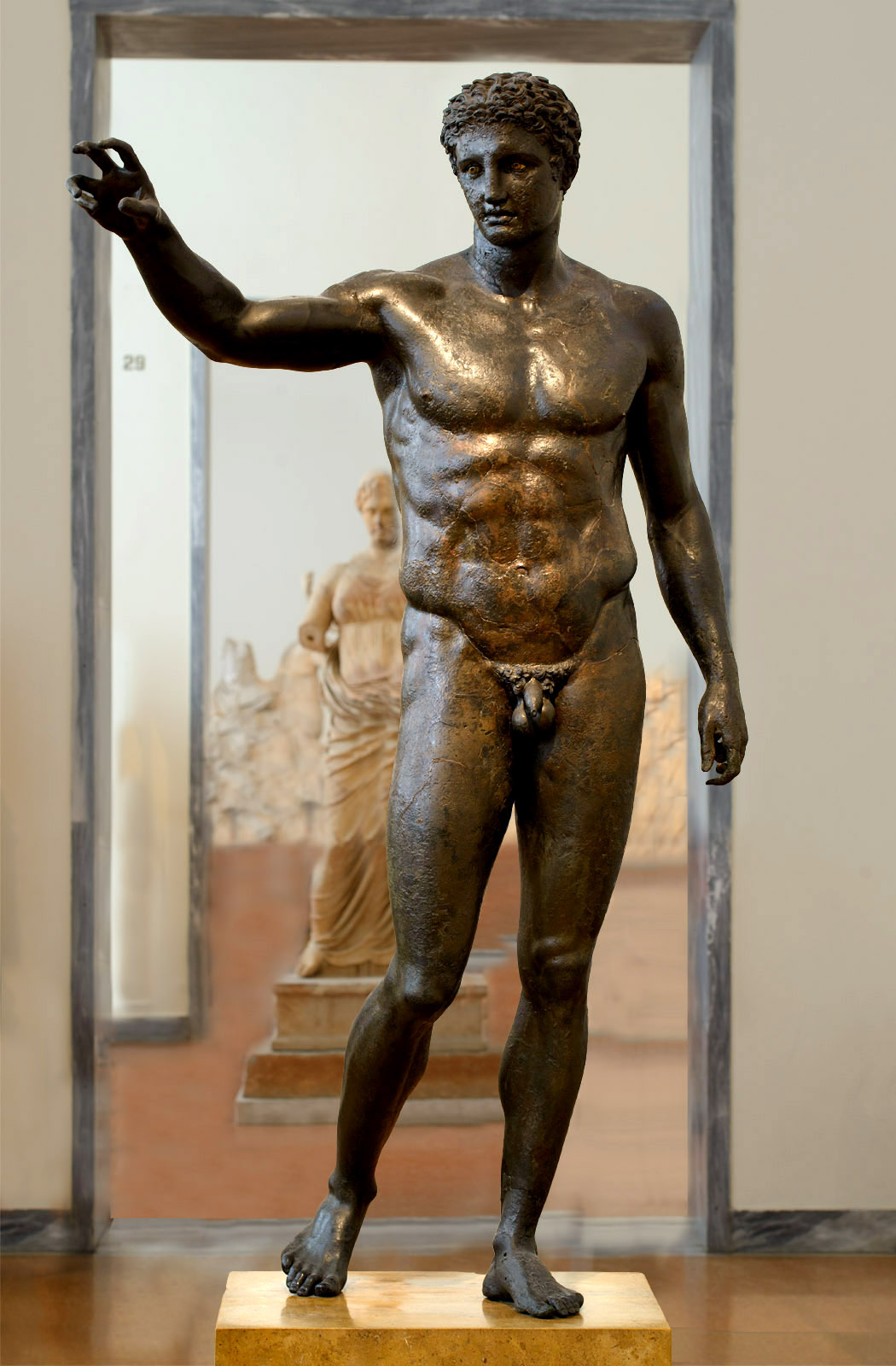
c. 340-330 BCE. An original Greek bronze recovered from a shipwreck. Identity debated (Paris? Perseus? athlete?). Shows the transition between Classical restraint and Hellenistic expressiveness.
Original vs Copy
These two sources offer a valuable contrast: the Apoxyomenos is a Roman marble copy (original bronze lost), while the Antikytheran Youth is a rare surviving Greek bronze original. This allows direct comparison of what we lose when studying Greek sculpture through Roman copies - and what we gain when we have the real thing.

Lysippos of Sikyon

Lysippos was the dominant sculptor of the late 4th century BCE and the last great name of Classical Greek sculpture. Key facts:

  • Court sculptor to Alexander: Only Lysippos was permitted to sculpt the king's portrait
  • Extraordinary output: Ancient sources credit him with 1,500 works (all lost in original form)
  • New Canon: Established new proportions - more slender than Polykleitos
  • Worked in bronze: Like most Greek sculptors, but we know his work only through marble copies
Lysippos' Philosophy
Ancient sources preserve a revealing quote: "Lysippos said that while other sculptors made men as they were, he made them as they appeared to be." This suggests interest in optical effects - how sculpture looks to the eye - rather than mathematical proportions alone. It's a shift from Polykleitos' rationalism toward something more perceptual, more concerned with the viewer's experience.

Key Vocabulary for This Lesson

Strigil
A curved metal scraping tool used by athletes to remove oil, sweat, and dirt from the body after exercise. The Apoxyomenos shows this action.
Spatial Extension
When sculpture reaches out into the viewer's space rather than staying within an imaginary frame. A key innovation of Lysippos.
Multiple Viewpoints
Sculpture designed to be viewed from many angles, with the composition changing as you walk around. Contrasts with earlier frontal emphasis.
Lysippan Proportions
The new, more slender body proportions established by Lysippos: head 1/8 of body height (vs Polykleitos' 1/7). Creates taller, more elegant figures.
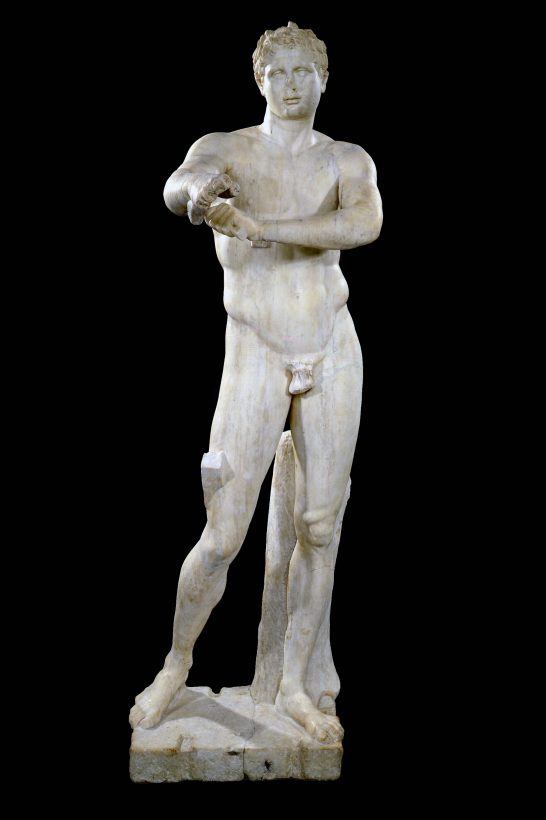
Apoxyomenos (The Scraper)

Original by Lysippos c. 330 BCE | Roman marble copy | Height: 205 cm | Vatican Museums, Rome
Apoxyomenos

Roman marble copy of Lysippos' Apoxyomenos. The athlete scrapes oil and dirt from his extended arm with a strigil. Note the slender proportions and arms projecting into space.

Description
Analysis
Essay Connections

What You Can See

The Action

A nude male athlete is shown scraping oil, sweat, and dust from his body using a strigil - a curved metal tool. Greek athletes oiled their bodies before exercise; afterwards, they scraped off the mixture of oil, sweat, and sand. This is that mundane, post-exercise moment.

The Pose and Composition

  • Arms extended forward: Both arms reach out in front of the body - the right arm is being scraped by the strigil held in the left hand
  • Breaking the frame: The arms project INTO the viewer's space, not contained within an imaginary box
  • Weight distribution: Contrapposto with weight on the right leg, but the pose is more complex than earlier examples
  • Head turned: The head turns slightly, gaze unfocused - he's absorbed in the task, not engaging the viewer

The Body

  • New proportions: The head is noticeably smaller relative to the body (1:8 ratio vs Polykleitos' 1:7)
  • Slender build: More elegant and elongated than the stocky Doryphoros
  • Athletic but not heroic: Realistic musculature without idealised exaggeration
  • Surface: In the marble copy, we lose the bronze original's subtle surface effects
A Favourite of Emperors
The Roman emperor Tiberius was so fond of this statue that he had it moved from public display to his private bedroom. The Roman people protested so loudly that he was forced to return it. This anecdote (from Pliny) shows how famous and beloved the work was in antiquity.

Lysippos' Revolutionary Innovations

1. New Proportions

Lysippos established a new system of bodily proportions that superseded Polykleitos' Canon:

Feature Polykleitos (Doryphoros) Lysippos (Apoxyomenos)
Head-to-body ratio 1:7 1:8
Overall effect Stocky, powerful Tall, elegant
Build Broad, athletic Slender, refined
Why Change the Canon?
Lysippos' quote - that he showed men "as they appeared, not as they were" - suggests he was concerned with optical effects. A smaller head makes the body appear taller and more graceful. This is about visual impact, not mathematical truth. It's a shift from rational idealism toward perceptual naturalism.

2. Extension into Space

Earlier Classical sculpture stayed within an imaginary rectangular frame - arms close to the body, composition essentially flat. The Apoxyomenos breaks this convention:

  • Arms extend FORWARD, projecting into the viewer's space
  • The sculpture occupies three dimensions actively, not passively
  • You can't fully appreciate it from one angle - you must walk around
  • This "invasion" of viewer space creates a new relationship between sculpture and audience

3. Multiple Viewpoints

The Apoxyomenos is designed to be viewed from many angles:

  • From the front: see the scraping action, arms crossing
  • From the side: see the depth of the extended arms
  • From behind: see the contrapposto and back musculature
  • No single "correct" viewpoint - each angle reveals something different
Contrast with Diskobolos
Myron's Diskobolos, though showing dramatic action, was designed primarily for frontal viewing - walk around it and the composition becomes confused. The Apoxyomenos represents a genuine advance in three-dimensional thinking. Use this contrast in essays about the development of spatial composition in Greek sculpture.

4. The Everyday Subject

The Apoxyomenos doesn't show a heroic action, divine moment, or athletic triumph. It shows an athlete doing something completely mundane - cleaning himself after exercise. This choice of subject is significant:

  • Elevates an ordinary moment to monumental art
  • Shows the athlete as human, not hero
  • Anticipates Hellenistic interest in everyday life
  • The beauty is in the body and its movement, not the action's significance
Remember: This is a Copy
The Vatican Apoxyomenos is a Roman marble copy of Lysippos' bronze original. We've lost: the bronze surface and patina, the inlaid eyes, the fine details, the original proportions (copies often alter them slightly). The tree-trunk support is a Roman addition - bronze doesn't need it. Always acknowledge this in essays.

Essay Connections

Use this source when essays ask about these themes. Each connection includes what to argue and what to compare.

📐
Changing Proportional Systems
The Argument
Greek sculptors developed different systems of ideal proportion over time. Lysippos' new canon (1:8 head-to-body) replaced Polykleitos' (1:7), creating taller, more elegant figures. This shift reflects changing aesthetic values - from mathematical rationalism to optical naturalism.
Evidence to Use
  • Apoxyomenos has noticeably smaller head than Doryphoros
  • Body appears taller, more slender, more elegant
  • Lysippos' quote: showed men "as they appeared, not as they were"
  • Shift from rational ideal to perceptual effect
Compare With
Doryphoros (Polykleitos' Canon - 1:7 ratio, stockier build) • Hermes and Dionysus (Praxiteles - also elongated but different approach) • Trace development: Doryphoros → Hermes → Apoxyomenos
🔲
Sculpture and Space
The Argument
Greek sculpture progressively developed more sophisticated relationships with three-dimensional space. Lysippos' Apoxyomenos represents a breakthrough - arms extending into the viewer's space, demanding movement around the work.
Evidence to Use
  • Arms project forward, breaking the imaginary "frame"
  • Designed for multiple viewpoints - no single correct angle
  • Composition changes as viewer moves around
  • Viewer must engage actively with the sculpture
Compare With
Diskobolos (primarily frontal despite action) • Doryphoros (self-contained, works from front) • Antikytheran Youth (also extends into space) • New York Kouros (rigidly frontal)
🏃
The Everyday vs the Heroic
The Argument
The Apoxyomenos elevates a mundane moment (scraping off oil) to monumental art. This shift from heroic action to everyday activity anticipates Hellenistic interest in ordinary life and humanises the athletic ideal.
Evidence to Use
  • Subject is post-exercise cleaning, not athletic triumph
  • Athlete shown absorbed in mundane task, not engaging viewer
  • Beauty in the body itself, not the action's significance
  • Humanises rather than heroises the athlete
Compare With
Diskobolos (heroic athletic action, moment of triumph) • Doryphoros (walking with spear - dignified, purposeful) • Hermes and Dionysus (god in quiet, human moment - similar humanising tendency)
📋
The Problem of Roman Copies
The Argument
We know Lysippos' work only through Roman marble copies of lost bronze originals. This raises questions about accuracy, translation between media, and what we can really know about Greek sculptural achievement.
Evidence to Use
  • Bronze original lost - probably melted down
  • Marble requires support struts bronze doesn't need
  • Surface effects, inlaid eyes, fine details lost
  • Proportions may be slightly altered in copying
Compare With
Antikytheran Youth (original bronze - see what we're missing) • Artemision Zeus (original bronze) • Doryphoros, Diskobolos (also copies) • Hermes and Dionysus (possibly original - debated)

Antikytheran Youth

c. 340-330 BCE | Bronze | Height: 196 cm | National Archaeological Museum, Athens
Antikytheran Youth

The Antikytheran Youth - an original Greek bronze masterpiece recovered from the sea in 1900-1901. The right arm extends forward, originally holding a now-lost object.

Description
Analysis
Essay Connections

What You Can See

The Figure

A nude young man stands in relaxed contrapposto, right arm extended forward, gaze directed at something he once held in his right hand (now lost). The left arm hangs at his side. The figure combines athletic beauty with a contemplative, almost dreamy quality.

The Pose

  • Contrapposto: Weight on the left leg, right leg relaxed - the classic Greek weight-shift
  • Extended arm: Right arm reaches forward into space, like the Apoxyomenos
  • Gaze: Eyes focus on the (lost) object in the hand - creates a self-contained narrative moment
  • Head tilt: Slight inclination adds to the contemplative mood

The Body and Surface

  • Youthful build: Slender, elegant proportions - not the heavy musculature of earlier athletes
  • Bronze surface: Original patina partially preserved; shows the subtle modelling possible in bronze
  • Details: Copper inlays for lips and nipples survive; eyes (originally inset) are lost
  • Hair: Carefully detailed curls, bound with a fillet (headband)
The Antikythera Shipwreck
In 1900-1901, Greek sponge divers discovered an ancient shipwreck off the island of Antikythera. Among its treasures were this bronze youth and the famous Antikythera Mechanism - an ancient analogue computer for predicting astronomical events. The ship was probably carrying Greek art treasures to Rome when it sank around 70-60 BCE.

Who Is He? The Identity Debate

The figure's identity remains uncertain because we don't know what he held in his right hand. Main theories:

Paris
The Trojan prince holding the Apple of Discord, about to award it to Aphrodite. Would explain the contemplative gaze - he's deciding who is fairest.
Perseus
The hero holding the head of Medusa, gazing at it carefully (avoiding direct eye contact). The extended arm keeps the dangerous head at distance.
Herakles
Holding the golden apples of the Hesperides. Less commonly proposed but fits the contemplative moment.
Athlete
A victorious athlete holding a prize or attribute. The youthful, athletic body supports this reading.
Current Thinking
Most scholars now favour the identification as Paris, based on the contemplative quality and the pose suggesting careful examination of an object. However, without the object itself, certainty is impossible. For exam purposes, acknowledge the debate rather than committing to one identification.

A Transitional Work

The Antikytheran Youth dates to c. 340-330 BCE - right at the boundary between Late Classical and Hellenistic periods. It shows characteristics of BOTH:

Classical Features Proto-Hellenistic Features
Idealised, beautiful body Extension into viewer's space
Calm, restrained expression Psychological moment captured
Dignified contrapposto Designed for multiple viewpoints
Idealised facial features Hint of individual character
The Contemplative Moment
Like the Hermes of Praxiteles, the Antikytheran Youth shows a figure absorbed in a private moment of thought. We see him looking at something, considering it - but we can't share his thoughts. This psychological inwardness, combined with physical beauty, is characteristic of Late Classical sculpture's move toward emotional depth.

Attribution: Who Made This?

The sculptor is unknown, but several attributions have been proposed:

  • School of Lysippos: The slender proportions and spatial extension suggest Lysippan influence
  • Euphranor: A 4th-century sculptor known for elegant figures - some see his style here
  • Unknown master: May be by an excellent sculptor whose name hasn't survived
Essay Approach
Don't worry about the attribution debate for essays. Focus on what we CAN say: the date (c. 340-330), the style (transitional Late Classical/Early Hellenistic), and the comparison with known works like the Apoxyomenos. The uncertainty about the sculptor is less important than what the statue tells us about stylistic development.

The Value of an Original Bronze

Unlike most major Greek sculptures (known only through Roman copies), the Antikytheran Youth is an original Greek bronze. This allows us to see:

Surface Quality
The subtle modelling of flesh, the gradual transitions between forms, the way light plays across bronze - impossible to reproduce in marble.
Fine Details
Copper inlays for lips and nipples, detailed hair treatment, the original (lost) inlaid eyes. Roman copies lose these details.
True Proportions
No copyist's "interpretation" - we see exactly what the Greek sculptor intended. Proportions in marble copies are often slightly altered.
No Supports
Bronze is self-supporting - no ugly marble struts or tree trunks. The figure stands freely as intended.
Condition Issues
Despite being an original, the Antikytheran Youth has suffered: the eyes are lost, the right arm was damaged and is partially restored, surface corrosion has affected some details. It's not perfect - but it's still infinitely more authentic than any Roman copy.

Comparison: Apoxyomenos vs Antikytheran Youth

These two contemporary works share features but differ in important ways:

Aspect Apoxyomenos Antikytheran Youth
Medium Roman marble copy (bronze lost) Original Greek bronze
Subject Athlete scraping (mundane action) Mythological? (Paris/Perseus/athlete)
Mood Absorbed in practical task Contemplative, thoughtful
Arms Both extended, working One extended, one relaxed
Spatial Extension Dramatic - both arms forward Subtler - one arm forward
Attribution Definitely Lysippos Unknown (Lysippan school?)

Essay Connections

Use this source when essays ask about these themes. Each connection includes what to argue and what to compare.

🥉
Original Bronzes vs Roman Copies
The Argument
The Antikytheran Youth is one of very few surviving original Greek bronzes. Comparing it to works known only through copies reveals what we lose in translation: surface quality, fine details, true proportions, freedom from supports.
Evidence to Use
  • Original bronze surface with subtle modelling
  • Copper inlays for lips and nipples survive
  • No support struts - figure stands freely
  • Proportions are exactly as sculptor intended
  • Hair detail shows bronze-working virtuosity
Compare With
Apoxyomenos (contemporary but only known through copy) • Artemision Zeus (another original bronze) • Doryphoros, Diskobolos (lost bronzes, known through marble copies)
🔄
Stylistic Transition
The Argument
The Antikytheran Youth stands at the boundary between Late Classical and Hellenistic, showing features of both. It demonstrates that stylistic change is gradual, not sudden - artists don't wake up "Hellenistic" one day.
Evidence to Use
  • Classical: idealised body, calm expression, dignified contrapposto
  • Hellenistic: spatial extension, psychological moment, multiple viewpoints
  • Dated c. 340-330 - just before Alexander's death (323)
  • Shows gradual evolution, not sudden break
Compare With
Trace the full development: Doryphoros (High Classical) → Hermes and Dionysus (Late Classical) → Antikytheran Youth/Apoxyomenos (transitional) • Eirene and Ploutos (another transitional work)
🧠
Psychology and Inner Life
The Argument
Late Classical sculpture develops new interest in the subject's inner world. The Antikytheran Youth shows a figure absorbed in contemplation - gazing at an object, lost in thought. We're invited to wonder what he's thinking.
Evidence to Use
  • Gaze directed at object in hand - focused, contemplative
  • Slight head tilt adds to thoughtful quality
  • Private moment - not engaging the viewer
  • If Paris: shown at moment of consequential decision
Compare With
Hermes and Dionysus (also dreamy, introspective) • Doryphoros (dignified but psychologically blank) • Delphic Charioteer (concentrated but not contemplative)
Problems of Interpretation
The Argument
The Antikytheran Youth illustrates the limits of our knowledge about Greek sculpture. Without the object he held, we can't identify him with certainty. Much interpretation of Greek art involves informed speculation.
Evidence to Use
  • Multiple identifications proposed: Paris, Perseus, Herakles, athlete
  • Each depends on what the lost object might have been
  • Sculptor unknown - can only suggest "school of" attributions
  • Shows limits of archaeological interpretation
Compare With
Hermes and Dionysus (original or copy? debated) • Artemision Zeus (Zeus or Poseidon? depends on lost attribute) • Many interpretive questions across Greek sculpture

Thematic Overview: The End of Classical Sculpture

This lesson covers the final phase of Classical Greek sculpture. Here's how to use these sources thematically in essays.

The Complete Development of Greek Sculpture

With these sources, you can now trace the entire development of freestanding Greek sculpture:

Period Dates Key Characteristics Prescribed Sources
Archaic c. 600-480 BCE Rigid frontal poses, stylised forms, Archaic smile, Egyptian influence New York Kouros, Kleobis and Biton, Anavysos Kouros, Peplos Kore, Aristodikos Kouros, Berlin Standing Goddess
Early Classical / Severe c. 480-450 BCE Contrapposto introduced, serious expressions, increased naturalism Delphic Charioteer, Artemision Zeus
High Classical c. 450-400 BCE Perfect balance, mathematical proportion, idealised beauty, ethos Doryphoros, Diskobolos
Late Classical c. 400-323 BCE Softer forms, S-curves, emotional depth, first female nude Aphrodite of the Agora, Eirene and Ploutos, Hermes and Dionysus, Aphrodite of Knidos
Transitional / Early Hellenistic c. 340-300 BCE New proportions, spatial extension, multiple viewpoints, everyday subjects Apoxyomenos, Antikytheran Youth

Key Innovations of Lysippos and His Circle

New Proportions
Head 1/8 of body (vs Polykleitos' 1/7). Creates taller, more elegant figures. Reflects interest in optical effect over mathematical truth.
Spatial Extension
Figures reach into viewer's space. Arms extend forward, breaking the imaginary "frame." Sculpture becomes truly three-dimensional.
Multiple Viewpoints
No single correct viewing angle. Composition changes as viewer moves around. Demands active engagement with sculpture.
Everyday Moments
Mundane actions (scraping oil) become worthy subjects. Athletes shown as human, not heroic. Anticipates Hellenistic diversity.

Polykleitos vs Lysippos: A Key Comparison

Aspect Polykleitos (Doryphoros) Lysippos (Apoxyomenos)
Proportions 1:7 head-to-body ratio 1:8 head-to-body ratio
Philosophy "Men as they are" (mathematical truth) "Men as they appear" (optical effect)
Space Self-contained, within imaginary frame Extends into viewer's space
Viewpoint Primarily frontal Multiple angles equally valid
Subject Heroic spear-bearer (purposeful action) Athlete scraping (mundane moment)
Build Stocky, athletic, powerful Slender, elegant, refined
Using This Comparison
The Polykleitos vs Lysippos comparison is perfect for essays about stylistic development in Greek sculpture. It shows how the Classical ideal evolved: from mathematical rationalism to perceptual naturalism, from heroic subjects to everyday moments, from frontal display to spatial complexity. Use specific evidence from both works to support your points.

Quick Reference: Source Summary

Source Artist Date Key Points
Apoxyomenos Lysippos c. 330 BCE New proportions (1:8). Arms extend into space. Multiple viewpoints. Mundane subject. Roman marble copy (original bronze lost).
Antikytheran Youth Unknown (Lysippan school?) c. 340-330 BCE Original Greek bronze. Identity debated (Paris? Perseus?). Contemplative moment. Transitional Classical/Hellenistic features.

Essay Planning: From This Lesson

Polykleitos vs Lysippos
Compare Doryphoros and Apoxyomenos. Cover: proportional systems, spatial composition, viewing angles, subject matter. Show evolution of Classical ideal.
Originals vs Copies
Compare Antikytheran Youth (original) with works known through copies. Cover: what we lose in copying, what originals reveal, problems of studying Greek art.
Stylistic Development
Trace full development using all prescribed sources. Show gradual evolution across periods. Antikytheran Youth as transitional example.
Space in Greek Sculpture
Trace development from frontal (kouroi) to spatial (Apoxyomenos). Cover: contrapposto, breaking the frame, multiple viewpoints, viewer engagement.