2.3 High Classical Sculpture

Topic 2: Freestanding Sculpture 60 min Polykleitos & Myron

The Golden Age of Greek Sculpture

This lesson covers the High Classical period (c. 450-400 BCE) - the absolute peak of Greek sculptural achievement. This was the age of Pericles, the Parthenon, and the perfection of the human form in art.

Why This Period is Called "High" Classical
The term "High Classical" indicates this is the pinnacle - the moment when all the experiments of the Archaic and Severe Style periods come together into a perfect synthesis. Balance, proportion, idealisation, and naturalism all reach their fullest expression. Everything before was building towards this; everything after will react against it or develop it further.

The Two Prescribed Sources

Doryphoros (Spear-Bearer)
By Polykleitos of Argos, c. 450-440 BCE. The physical embodiment of his theoretical Canon - mathematical perfection made visible. Known only through Roman copies.
Discobolus (Discus Thrower)
By Myron of Athens, c. 460-450 BCE. The body in dynamic action, frozen at the moment of maximum tension. Also known only through Roman copies.
Critical Point: We Have NO Originals
Both the Doryphoros and Discobolus survive ONLY as Roman marble copies. The original bronzes by Polykleitos and Myron were lost (probably melted down). This matters because: (1) copies may not be perfectly accurate, (2) marble behaves differently from bronze (hence the ugly tree-trunk supports), (3) surface details may differ. ALWAYS mention this in essays - it shows sophisticated understanding.

The Two Great Sculptors

Polykleitos of Argos

Working primarily in bronze, Polykleitos was both a practical sculptor and a theorist. He wrote a treatise called the Canon (meaning "rule" or "measure") setting out the mathematical proportions for the perfect human body. The Doryphoros was his demonstration piece - literally called "the Canon" because it embodied his theory.

Myron of Athens

Also a bronze sculptor, Myron was celebrated for capturing the body in motion. Ancient sources praise his ability to freeze split-second moments of athletic action. Where Polykleitos theorised about proportion at rest, Myron explored dynamic equilibrium in movement.

Two Approaches, One Ideal
Polykleitos and Myron represent complementary approaches to the Classical ideal:
Polykleitos: Perfect proportion in the standing figure at rest
Myron: Perfect balance in the body caught in action
Both create idealised, beautiful bodies; both balance naturalism with perfection; both work within Classical principles of harmony and restraint.
Key Vocabulary for This Lesson

Canon
Polykleitos' theoretical treatise on ideal proportions. Also refers to the Doryphoros itself as the physical demonstration of the theory.
Symmetria
Not "symmetry" in the modern sense, but "commensurability" - the mathematical relationship between parts. Every part should relate proportionally to every other part.
Chiasmus / Chiastic Balance
A cross-pattern of tensions: if the right leg is engaged, the left arm is active (and vice versa). Creates dynamic balance through opposition.
Rhythmos
The visual "rhythm" created by the alternating engaged/relaxed pattern of the limbs. Gives the figure a sense of life and potential movement.

Doryphoros (Spear-Bearer)

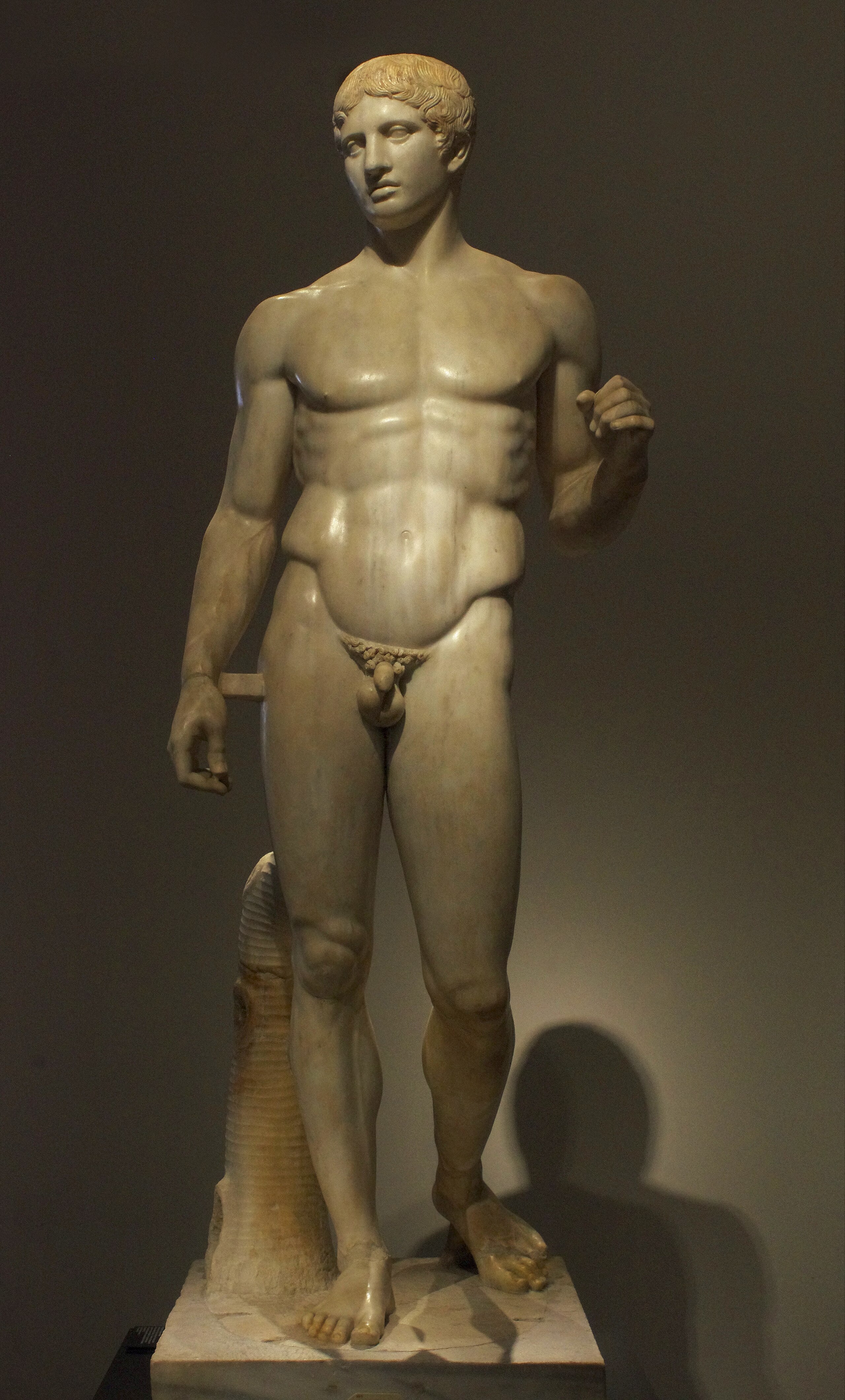
Original by Polykleitos c. 450-440 BCE | Roman marble copies | Height: c. 212 cm | Best copy: Naples National Archaeological Museum
Doryphoros

The Naples Doryphoros - the best-preserved Roman copy of Polykleitos' masterpiece. The tree-trunk support is a Roman addition necessitated by marble.

Description
Analysis
Thematic Links

What You Can See

The Figure

A nude young man in the prime of athletic youth. He strides forward, originally carrying a spear over his left shoulder (now lost in most copies - hence "Spear-Bearer"). The body is muscular but not exaggeratedly so - idealised athletic perfection rather than bodybuilder bulk.

The Contrapposto - Fully Developed

The Doryphoros represents the full flowering of contrapposto, first seen tentatively in the Kritios Boy. Here it's a complete, theorised system:

  • Right leg: Straight, bearing the body's weight - the engaged/standing leg
  • Left leg: Bent, trailing behind, only the toes touching ground - the free/relaxed leg
  • Pelvis: Tilts down on the left (free leg) side
  • Spine: Curves to compensate for the hip tilt
  • Shoulders: Tilt in the OPPOSITE direction to the hips (right shoulder drops)

The Chiastic Pattern

Look at the diagonal pattern of tension and relaxation:

  • Right side: Engaged leg + relaxed arm (hanging at side)
  • Left side: Relaxed leg + engaged arm (holding spear)

This creates a cross-pattern (chiasmus) of tensions that balances the figure dynamically.

The Head and Face

The head turns slightly to the right, breaking strict frontality. The face is:

  • Idealised - no individual features or expression
  • Calm, almost blank - Classical ethos
  • Youthful but mature - prime of manhood
  • Hair in short, neat curls close to the head
Multiple Copies Exist
The Doryphoros was so famous in antiquity that Romans made many copies. We have over 30 surviving copies or fragments! The Naples copy is considered the best, but others exist in Minneapolis, Florence, and elsewhere. Comparing copies helps scholars understand what the lost original might have looked like.

The Canon: Polykleitos' Theory of Proportion

Polykleitos didn't just make beautiful sculptures - he theorised about WHY they were beautiful. His written treatise (now lost) was called the Canon, meaning "rule" or "standard." The Doryphoros was created as the physical demonstration of this theory.

What the Ancient Sources Tell Us
The 2nd-century CE physician Galen preserved this summary of Polykleitos' theory:

"Beauty consists in the proportions, not of the elements, but of the parts, that is to say, of finger to finger, and of all the fingers to the palm and the wrist, and of these to the forearm, and of the forearm to the upper arm, and of all the parts to each other, as they are set forth in the Canon of Polykleitos."

What is Symmetria?

The key concept is symmetria - NOT symmetry in our sense, but "commensurability." Every part of the body should bear a mathematical relationship to every other part and to the whole. Scholars have tried to work out the exact ratios:

  • The head is approximately 1/7 of total height (later, Lysippos would make it 1/8)
  • The face is 1/10 of total height
  • Every part relates proportionally to every other
The Lost Treatise
We don't have Polykleitos' actual text - only later summaries and references. This means scholars disagree about exactly what his system was. Some think he used a modular system based on the finger-width as the basic unit. Others propose different mathematical relationships. The exact Canon remains partly mysterious.

Why This Matters

Polykleitos believed that beauty was objective and mathematical - not a matter of taste, but of correct proportion. This is a profoundly Greek idea, connected to:

  • Pythagorean philosophy: The universe is structured by mathematical ratios (also seen in music)
  • Architectural theory: The same proportional thinking appears in temple design
  • Medical theory: Health as balance of bodily elements

The Doryphoros embodies the Greek belief that beauty, harmony, and mathematical order are connected.

Essay Vocabulary
For the Doryphoros, use these terms: "Canon," "symmetria," "chiastic balance," "contrapposto," "idealisation," "mathematical proportion," "engaged/relaxed," "rhythmos." Show you understand that this isn't just a pretty statue - it's a theoretical demonstration of what perfect proportion means.

Comparing to Earlier Works

Aspect Kritios Boy (c. 480) Doryphoros (c. 450-440)
Contrapposto Subtle, tentative weight shift Fully developed, theorised system
Chiasmus Not fully articulated Complete cross-pattern of tensions
Theory No known theoretical basis Demonstrates written Canon
Proportions Naturalistic but not systematised Mathematical relationships throughout
Effect First step into Classical world Perfection of Classical ideal

Connecting to Bigger Themes

Discobolus (Discus Thrower)

Original by Myron c. 460-450 BCE | Roman marble copies | Height: c. 155 cm | Best copy: Palazzo Massimo, Rome (Lancellotti Discobolus)
Discobolus

The Lancellotti Discobolus - considered the best Roman copy of Myron's famous bronze. Note the complex torsion and the calm facial expression.

Description
Analysis
Thematic Links

What You Can See

The Pose - Frozen Motion

An athlete caught at the extreme moment of the discus throw - specifically, the end of the backswing, the split second before the arm whips forward to release the disc. The body is coiled like a spring, full of potential energy about to explode into action.

  • Right arm: Extended back, holding the discus at the furthest point of the backswing
  • Left arm: Bent across the knee, helping balance
  • Torso: Twisted dramatically - the chest faces one direction, the hips another
  • Legs: Bent, feet planted, weight distributed for the explosive forward motion to come
  • Head: Turned to look back at the discus (though some copies show it facing forward - probably incorrectly)

The Body

The anatomy responds to the dramatic pose:

  • Muscles are tense, stretched, activated
  • The torso shows the twist through the ribcage and abdomen
  • Veins and tendons might have been visible in the bronze original
  • Idealised but anatomically informed - this is how a body WOULD look in this position

The Face - The Surprise

Here's the remarkable thing: despite the extreme physical effort, the face is CALM. Serene. Almost blank. No grimacing, no strain, no emotion. This contrast between bodily dynamism and facial tranquility is quintessentially Classical.

Ethos, Not Pathos
The calm face shows Classical ethos - dignified character that remains composed even under stress. The Greeks valued self-control; the ideal athlete didn't show strain or emotion. Compare this to Hellenistic works where faces contort with effort and feeling. The Discobolus is powerful precisely because it contains that power within dignified restraint.

Myron's Achievement: Capturing the Moment

Ancient sources praise Myron for his ability to capture fleeting instants of action. The Roman author Pliny says Myron "was the first to broaden the scope of realism" and excelled at showing bodies in motion. The Discobolus is his masterpiece of frozen movement.

Why This Moment?

Myron chose the precise instant of maximum tension - the pause at the end of the backswing, just before the forward throw begins. This is significant:

  • Maximum potential energy: All the power is coiled, ready to release
  • Stillness within movement: For one instant, the figure is actually still - making it possible to sculpt
  • Anticipation: We know what's about to happen; we feel the tension
  • Timelessness: The moment is frozen forever, never completing the throw
Not Anatomically "Accurate"?
Modern athletes have noted that this isn't actually how you throw a discus - the pose is slightly exaggerated for visual effect. Myron prioritised artistic impact over strict accuracy. The twisted torso shows more rotation than a real throw would have. This reminds us that "naturalism" in Greek art always involved idealisation and artistic choice, not just copying nature.

The Viewing Problem

The Discobolus works best from ONE viewpoint - roughly frontal, seeing the full spiral of the body. Walk around it and the composition becomes confusing. This is characteristic of Classical sculpture:

  • Designed for a primary viewing angle (like a relief, almost)
  • Not yet fully three-dimensional in conception
  • Compare to Hellenistic works designed to be walked around
Bronze Original vs Marble Copies
The original was bronze - hollow, self-supporting, with fine surface detail. Marble copies required adding the tree-trunk support (visible in most copies) and the strut connecting the hand to the leg. These clumsy additions significantly change the visual effect. In the bronze, the figure would have seemed to float, unsupported, capturing that frozen instant with nothing weighing it down.

Comparing Doryphoros and Discobolus

Aspect Doryphoros (Polykleitos) Discobolus (Myron)
Movement At rest (walking slowly) Frozen mid-action
Focus Proportion and balance Capturing the moment
Body Relaxed contrapposto Extreme torsion and tension
Theory Demonstrates the Canon No known written theory
Expression Calm, idealised Calm despite action
Viewing Works from multiple angles Primarily frontal

Both are High Classical masterpieces; both balance naturalism and idealisation; both maintain dignified ethos. But they explore different aspects of what sculpture can do.

Connecting to Bigger Themes

Thematic Overview: The High Classical Achievement

Now that you know both sources in detail, here's how to think about them thematically for essays and exams.

Theme 1: The Classical Ideal

High Classical sculpture represents a perfect balance of seeming opposites:

Naturalism + Idealisation
Bodies are anatomically accurate - muscles, bones, tendons all correctly shown. But they're also perfected beyond any real human. This is nature improved, idealised, made perfect.
Movement + Stability
Even in dynamic poses (Discobolus) or mid-stride (Doryphoros), the figures are balanced, stable, harmonious. Energy is contained, not chaotic.
Individual + Universal
Each body is specific - THIS athlete, THIS pose. But they also represent universal ideals - The Perfect Athlete, The Ideal Man.
Physical + Moral
The beautiful body implies the good soul. Kalos kagathos - beautiful and good - were inseparable for the Greeks.

Theme 2: Theory and Practice

The High Classical period sees art become theoretical. Polykleitos writes the Canon; beauty becomes mathematical; proportion can be taught. This has huge implications:

  • Art is intellectual, not just intuitive
  • Beauty is objective, not subjective
  • Perfect proportion connects to philosophical ideas about order in the universe
  • The artist is a thinker, not just a craftsman
Using This in Essays
When discussing the Doryphoros, emphasise that it's not just a beautiful statue but a theoretical demonstration. Polykleitos created art AND wrote about it. This intellectual approach distinguishes High Classical sculpture from earlier work and shows the Greeks treating art as a serious, reasoned discipline.

Theme 3: The Problem of Copies

Both our sources survive only as Roman marble copies of lost Greek bronzes. This affects everything:

What We've Lost What We Can Still See
The original bronze surface and patina The overall composition and pose
Fine details (inlaid eyes, etc.) The proportional system
The unsupported poses (no tree trunks) The general treatment of anatomy
Any painted elements The relationship of parts
The original artist's exact intentions Enough to understand Classical principles

Theme 4: Historical Context

High Classical sculpture coincides with the Athenian golden age:

  • 461-429 BCE: Age of Pericles - Athenian democracy and imperialism at their height
  • 447-432 BCE: Parthenon construction - Pheidias supervises the greatest building project
  • c. 450-440 BCE: Doryphoros created by Polykleitos in Argos
  • c. 460-450 BCE: Discobolus created by Myron in Athens

The confident, balanced, idealised art reflects a confident culture. After the Persian Wars, Greeks believed they'd triumphed through superior values. Art expressed those values: order, proportion, the perfectability of humanity.

Quick Reference: Source Summary

Source Artist Date Key Features
Doryphoros Polykleitos c. 450-440 BCE Canon in physical form. Chiastic balance. Mathematical proportion. Standing figure at rest.
Discobolus Myron c. 460-450 BCE Frozen motion. Extreme torsion. Calm face in action. Primarily frontal viewpoint.

Essay Comparison: Severe Style to High Classical

Aspect Severe Style (c. 480-450) High Classical (c. 450-400)
Contrapposto Introduced (Kritios Boy) Perfected, theorised (Doryphoros)
Expression Serious, contemplative Calm, idealised, almost neutral
Theory No known written theories Canon written by Polykleitos
Movement Dynamic but still developing (Artemision Zeus) Frozen moment perfected (Discobolus)
Ideal Emerging Classical ideal Full flowering of Classical ideal